AI tools can help students understand difficult concepts, organise ideas and explore unfamiliar subjects. However, an AI-generated answer should not automatically be treated as a verified fact. AI systems can produce information that sounds convincing but may contain outdated, incomplete or incorrect details.
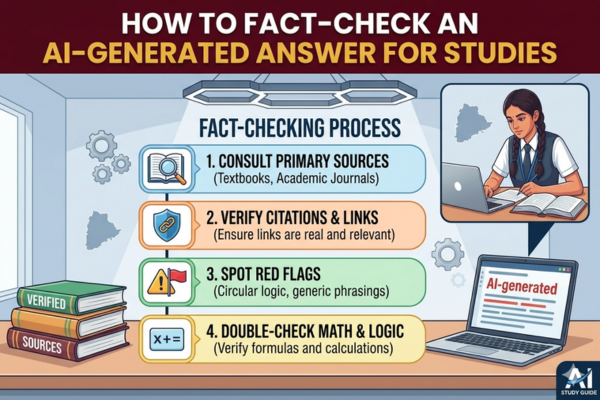
For students, learning how to fact-check AI-generated answers is therefore becoming an important digital research skill. The goal is not to avoid AI completely. Instead, students should learn how to use AI as a starting point and verify important information before including it in assignments, projects or academic work.
Why Should Students Fact-Check AI Answers?
AI systems generate responses based on patterns in information rather than acting as an infallible authority.
An answer may appear confident even when:
- A date is incorrect.
- A statistic is outdated.
- A source is misunderstood.
- Two different facts are combined incorrectly.
- A quotation is inaccurate.
- A website or reference does not actually support the claim.
Google itself has explained that AI-generated Search features can sometimes produce inaccurate results, particularly when information is scarce, ambiguous or difficult to interpret.
That is why verification remains important.
Step 1: Identify the Exact Claim
Do not try to fact-check an entire AI response at once.
Break the answer into individual claims.
For example:
“The examination has 1,000 total marks.”
That is one claim.
You can then search specifically for the official examination information that confirms or contradicts it.
This approach makes research more precise.
Step 2: Look for the Original Source
The strongest way to verify information is to locate the original or authoritative source.
For education-related questions, useful sources may include:
- Government websites
- Examination boards
- Universities
- Official institutional websites
- Regulatory organisations
- Published academic research
For example, when researching Telangana Intermediate examinations, students should prioritise information from the relevant Telangana education authorities rather than relying solely on social-media posts.
Google also provides tools that help users learn more about the source behind a search result.
Step 3: Check the Date
Information changes.
An AI answer about an examination rule, admission process, application deadline or syllabus may become outdated.
Always ask:
When was this information published or updated?
For current education information, a recent official notification should generally take priority over an old article.
This is especially important when students are researching admission requirements or examination rules.
Step 4: Compare More Than One Reliable Source
One webpage may contain an error.
Cross-check important claims against at least two reliable sources when possible.
For example, if an AI answer provides an examination date, students can compare the date with the official board notification and a reliable education publication.
Agreement between independent credible sources provides greater confidence.
Step 5: Be Careful With Numbers
Numbers deserve special attention.
Students should independently verify:
- Marks
- Percentages
- Dates
- Rankings
- Fees
- Statistics
- Eligibility requirements
- Exam durations
A small numerical error can completely change the meaning of an answer.
For example, if an AI system says an examination requires 35% marks, students should verify the current official criteria before using that figure in academic content.
Step 6: Check Whether the Source Actually Supports the Claim
Finding a source is not enough.
Read the relevant section and ask:
Does this source actually say what the AI answer claims it says?
This is one of the most important research habits students can develop.
A webpage may mention a topic without supporting the specific statement generated by AI.
Step 7: Watch for Fake or Unclear References
AI-generated answers may sometimes provide references that are difficult to verify.
Students should avoid using a citation simply because it looks academic.
Open the source.
Check the website.
Read the relevant passage.
Confirm that the document exists and that the information matches.
Step 8: Use AI as a Research Assistant, Not the Final Authority
A useful student workflow is:
Ask → Identify claims → Find sources → Verify → Compare → Use
This allows AI to help with brainstorming and explanation while keeping final academic decisions based on verified information.
UNESCO’s work on generative AI and education also emphasises the importance of responsible and human-centred use of AI in education.
Students can explore UNESCO’s guidance on generative AI in education for broader context.
Why This Skill Matters for Intermediate Students
Digital research skills are becoming increasingly useful across subjects. Whether students are studying science, commerce or humanities, they will encounter online information every day.
A student researching at a best junior college in Hyderabad should be able to distinguish between an AI-generated explanation and an authoritative source.
Similarly, students at a best junior college in Kompally need research habits that prepare them for higher education, where evidence, references and source evaluation become increasingly important.
Ignite Junior College highlights critical thinking and student-centred learning as part of its educational approach. Students can explore Ignite’s academic approach to learn more.
Conclusion
Knowing how to fact-check AI-generated answers is an essential skill for modern students. AI can save time and make difficult topics easier to explore, but students should verify important information before using it academically.
The safest approach is simple: identify the claim, find the original source, check the date, compare reliable references and confirm that the evidence actually supports the statement.
AI can help students find the starting point. Fact-checking helps them reach the right destination.
FAQs
Can students trust every AI-generated answer?
No. AI-generated answers can contain inaccurate, incomplete or outdated information. Important claims should be independently verified.
How do I fact-check an AI-generated answer?
Break the response into individual claims, find reliable sources, check publication dates and compare the information with authoritative references.
What sources are best for fact-checking education information?
Government websites, examination boards, universities, official institutions and credible academic or educational publications are useful sources.
Should students use AI for assignments?
AI can be useful for learning and brainstorming, but students should follow their institution’s academic-integrity rules and independently verify information.
Why is source verification important?
Source verification helps students avoid repeating incorrect information and develops research skills that are useful in higher education and future academic work.