Preparing for the Common Law Admission Test (CLAT) requires more than memorising facts or practising multiple-choice questions. One of the most important skills students need is reading comprehension.
CLAT includes passage-based questions that test understanding, interpretation, reasoning and analytical abilities. Students who struggle with lengthy passages may find it difficult to complete questions accurately within the examination time.
If you are wondering how to improve reading comprehension for CLAT, developing consistent reading habits and following the right practice methods can make a difference.
Here are seven practical CLAT reading comprehension tips for Intermediate students preparing for law entrance examinations.
Why Is Reading Comprehension Important for CLAT?
Reading comprehension plays an important role in multiple CLAT sections, including English Language, Legal Reasoning and Logical Reasoning.
According to the official CLAT syllabus, the English Language section tests students’ ability to understand passages, identify arguments, draw conclusions, summarise information and interpret vocabulary.
Students preparing through CLAT Coaching in Hyderabad with Intermediate should therefore focus on developing reading and analytical skills from their first year of Intermediate.
Strong comprehension skills can help students understand complex passages and answer questions more confidently.
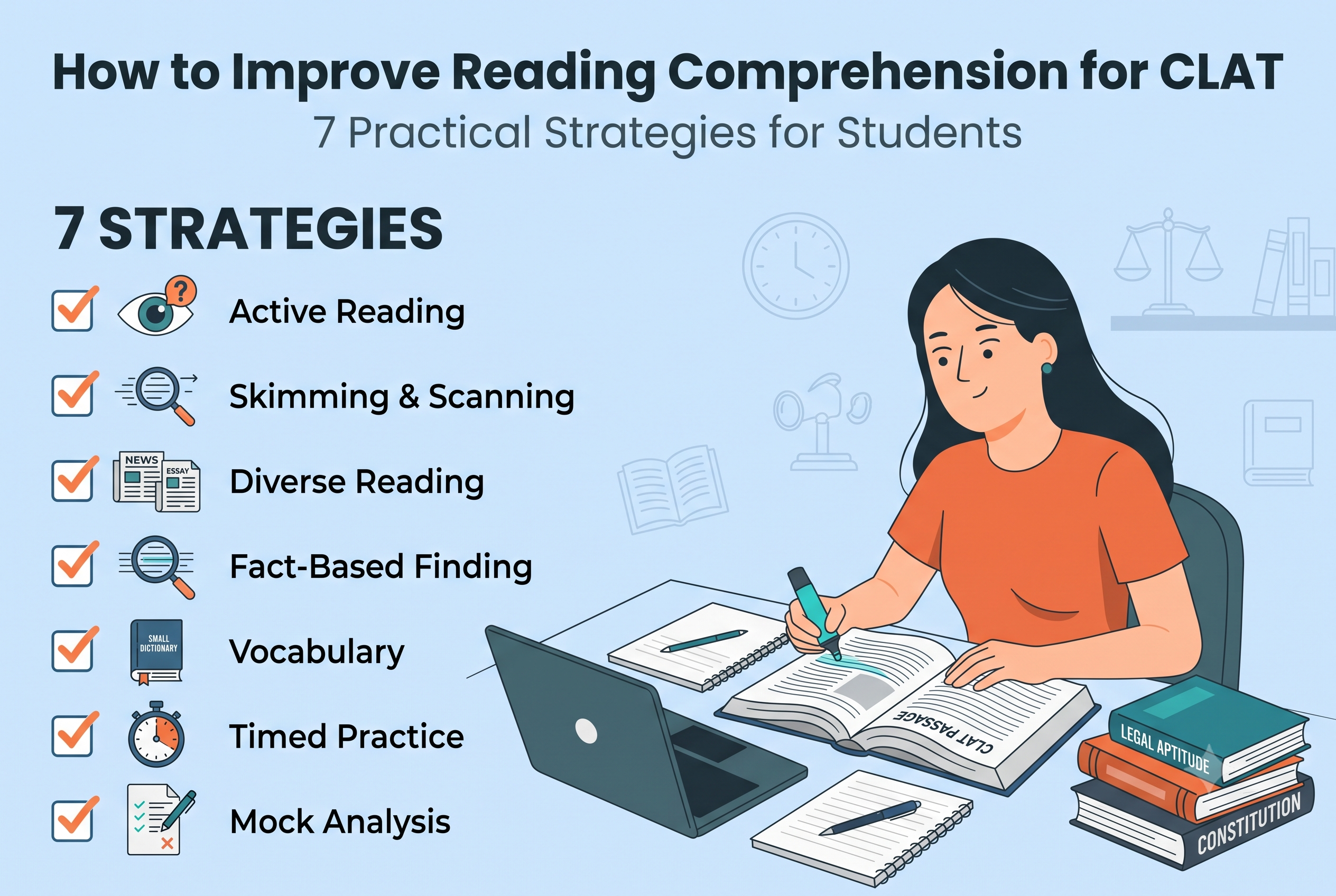
7 Practical Strategies to Improve CLAT Reading Comprehension
1. Develop a Daily Reading Habit
Reading regularly is one of the simplest ways to strengthen comprehension.
Start with 20–30 minutes of daily reading and gradually increase the complexity of the material.
Students can read:
- Newspaper editorials
- Educational articles
- Opinion pieces
- Historical essays
- Social and legal awareness articles
- Quality fiction and non-fiction
After reading, summarise the main argument in two or three sentences.
This helps improve understanding rather than simply increasing reading speed.
2. Identify the Main Idea of Every Passage
One of the most useful CLAT reading comprehension tips is to identify what the author is trying to communicate.
While reading, ask yourself:
- What is the central topic?
- What is the author’s main argument?
- What evidence supports the argument?
- What conclusion does the author reach?
Avoid focusing only on individual sentences. Understanding the overall message makes it easier to answer passage-based questions.
3. Improve Vocabulary Through Context
Students often believe they must memorise hundreds of difficult words to perform well in CLAT.
However, understanding vocabulary in context is equally important.
When you encounter an unfamiliar word:
- Read the sentence carefully.
- Identify clues from surrounding sentences.
- Predict the word’s meaning.
- Verify the meaning afterward.
- Practise using the word in another sentence.
This method helps students understand how language works within a passage.
4. Practise Inference-Based Questions
Inference questions require students to understand information that is suggested but not directly stated.
For example, a passage may discuss increasing environmental regulations without explicitly stating the author’s opinion.
Students must examine the argument and identify which conclusion is reasonably supported.
To improve inference skills:
- Separate facts from opinions.
- Identify supporting evidence.
- Avoid assumptions based on personal knowledge.
- Select answers supported by the passage.
Students pursuing CEC with CLAT Coaching in Hyderabad can benefit from practising inference questions alongside their Civics and Economics studies.
5. Learn to Recognise the Author’s Tone
The author’s tone refers to the attitude expressed in a passage.
Common tones include:
- Critical
- Analytical
- Optimistic
- Concerned
- Neutral
- Persuasive
Understanding tone can help students interpret arguments and identify the purpose of a passage.
For example, an author presenting balanced evidence may have an analytical tone, while an author strongly challenging a policy may have a critical tone.
Practise identifying the tone after reading each editorial or opinion article.
6. Practise Timed Reading Comprehension
Accuracy is important, but time management also matters during CLAT.
Begin by solving comprehension passages without strict time limits. Once your accuracy improves, introduce timed practice.
A simple approach is:
- Read the passage carefully.
- Identify the central argument.
- Answer the questions.
- Review incorrect responses.
- Record the time taken.
Avoid rushing through passages without understanding them.
Students looking for CLAT Coaching in Kompally should consider programmes that include regular comprehension exercises and timed practice.
7. Analyse Mistakes After Every Practice Test
Completing more questions does not automatically improve performance.
Students must understand why their answers were incorrect.
Maintain a notebook to record:
- Question type
- Incorrect answer
- Correct answer
- Reason for the mistake
- Improvement required
For example, if you frequently miss inference questions, spend additional time practising that question type.
Regular mistake analysis can help students improve accuracy and develop stronger reasoning habits.
Daily CLAT Reading Comprehension Practice Plan
Students can follow this simple 45-minute routine.
| Activity | Time |
|---|---|
| Read an editorial or article | 15 minutes |
| Solve a comprehension passage | 15 minutes |
| Practise vocabulary in context | 5 minutes |
| Review answers and mistakes | 10 minutes |
Consistency is more important than completing several passages without reviewing them.
Students preparing for CLAT alongside Intermediate should adjust this routine based on their academic schedule.
Common Reading Comprehension Mistakes to Avoid
Students should avoid these common mistakes:
- Reading too quickly without understanding the passage
- Selecting answers based on outside knowledge
- Ignoring the author’s central argument
- Spending excessive time on one question
- Memorising vocabulary without understanding context
- Skipping answer analysis after mock tests
Avoiding these mistakes can gradually improve comprehension accuracy.
CLAT Coaching in Hyderabad with Intermediate: Why Start Early?
Students beginning CLAT preparation after Class 10 have time to develop reading habits during their Intermediate education.
When comparing Junior Colleges in Hyderabad, students interested in law should consider whether the institution provides integrated CLAT preparation.
Students searching for CEC with CLAT Coaching in Kompally can explore programmes that combine Intermediate subjects with English, legal reasoning, logical reasoning and comprehension practice.
An integrated learning environment can help students maintain consistent preparation without treating Intermediate and CLAT as completely separate academic goals.
Why Choose Ignite Junior College for CLAT Preparation?
Ignite Junior College, located in Kompally, Hyderabad, offers integrated programmes such as CEC + CLAT and MEC + CLAT.
These programmes combine Intermediate academics with preparation in areas including English, reading comprehension, current affairs, legal reasoning, logical reasoning and quantitative techniques.
For parents comparing Junior Colleges in Kompally and Intermediate Colleges in Hyderabad, it is important to consider academic support, entrance preparation, faculty guidance and the overall learning environment.
Students interested in CLAT Coaching in Hyderabad with Intermediate can explore Ignite’s integrated programmes based on their academic interests and career goals.
Conclusion
Learning how to improve reading comprehension for CLAT requires consistent reading, critical thinking, vocabulary development and regular practice.
Students should focus on understanding the main argument, identifying the author’s tone, drawing logical inferences and reviewing mistakes after practice tests.
By following these seven CLAT reading comprehension tips, Intermediate students can gradually strengthen the skills required for passage-based questions.
For students planning a career in law, Ignite Junior College offers integrated CEC + CLAT and MEC + CLAT programmes in Kompally, Hyderabad.
Explore Ignite Junior College’s CLAT-integrated programmes and contact the admissions team to learn more.
Frequently Asked Questions
1. How can I improve reading comprehension for CLAT?
Read regularly, practise comprehension passages, identify main ideas, improve vocabulary in context and analyse mistakes after practice tests.
2. How much time should I spend on CLAT reading comprehension daily?
Beginners can start with 30–45 minutes of focused reading and comprehension practice, adjusting the duration according to their preparation level.
3. Is reading newspapers useful for CLAT?
Yes. Newspapers and editorials can help students improve reading comprehension, vocabulary, awareness of current affairs and understanding of arguments.
4. Can I prepare for CLAT during Intermediate?
Yes. Students can prepare for CLAT alongside Intermediate by following a structured timetable and practising regularly.
5. Is CEC suitable for CLAT preparation?
CEC can be suitable for students interested in law, public affairs and commerce. However, CLAT does not require a particular Intermediate stream.
6. Where can I find CLAT coaching in Kompally?
Ignite Junior College in Kompally offers integrated CEC + CLAT and MEC + CLAT programmes.
7. Does reading faster guarantee better CLAT scores?
No. Reading speed is useful, but comprehension, accuracy, reasoning and effective time management are equally important.