Are you planning to pursue management studies after Class 12? The Integrated Programme in Management (IPM) offered by the Indian Institutes of Management (IIMs) provides a pathway for students who want to begin their management education after school.
Two options students often compare are IIM Indore and IIM Rohtak. Although both institutions offer five-year integrated management programmes, their entrance examinations, admission criteria and selection processes have important differences.
Understanding IPMAT Indore vs IPMAT Rohtak can help students make informed decisions about their preparation strategy and future academic plans. This guide explains the main differences and how Intermediate students can prepare for these competitive entrance examinations.
What Is IPMAT?
IPMAT stands for Integrated Programme in Management Aptitude Test, a term commonly used for the entrance examinations associated with integrated management programmes.
IIM Indore conducts its own IPM Aptitude Test, while IIM Rohtak conducts a separate test for its programme. Other institutions may accept different examinations or follow different admission procedures.
Students should therefore understand each institution’s requirements instead of assuming that one entrance examination automatically covers every IIM’s programme.
IPMAT Indore vs IPMAT Rohtak: Key Differences
1. Programme and Institution
IIM Indore offers a five-year Integrated Programme in Management designed to introduce students to foundational and advanced areas of management education.
IIM Rohtak also offers a five-year Integrated Programme in Management for students entering after Class 12.
Both programmes are worth researching, but students should compare the curriculum, academic environment, fees, campus facilities and admission requirements before choosing their preferred institutions.
2. Entrance Examination Pattern
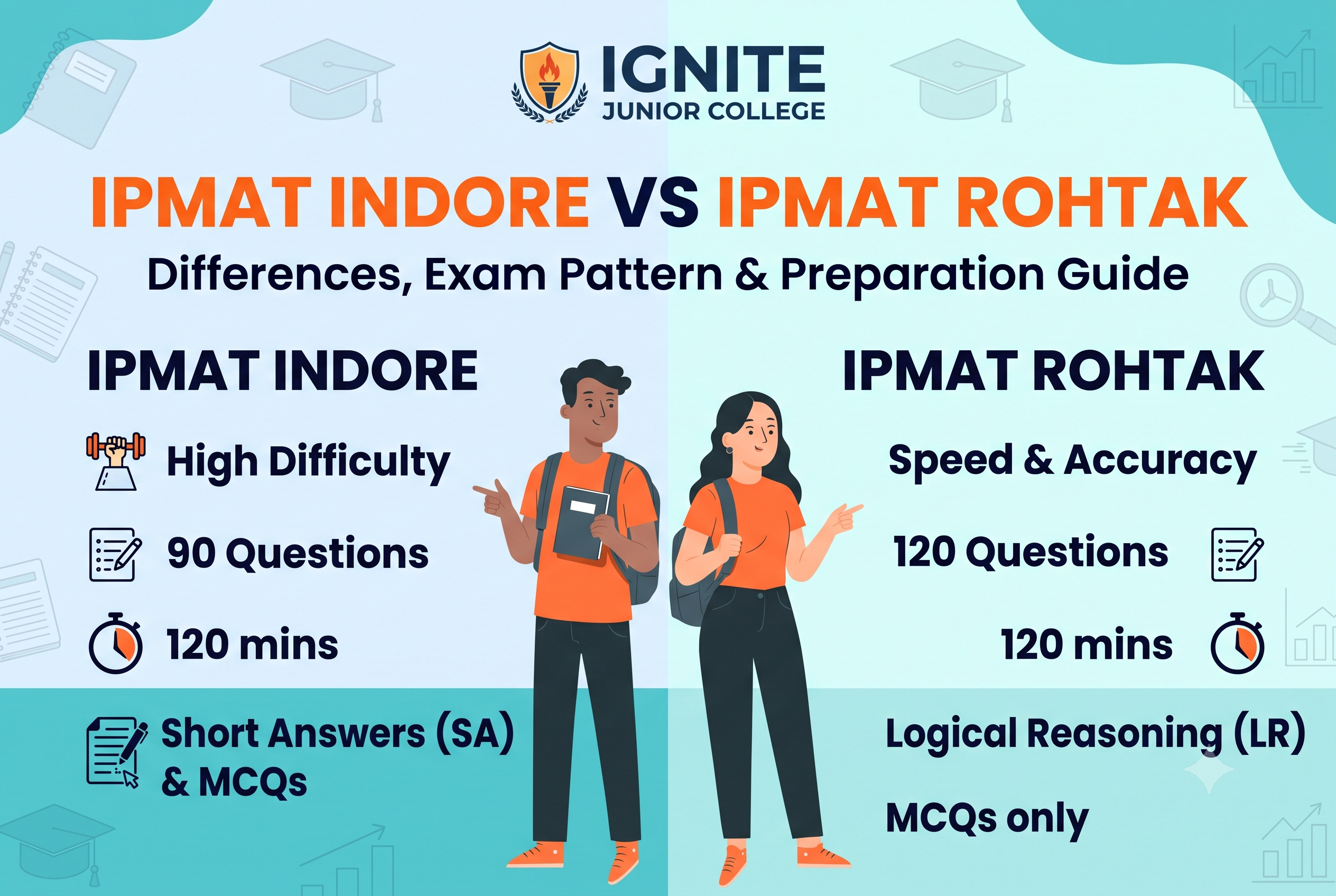
The examination structures for IIM Indore and IIM Rohtak are not identical. The sections, question formats, marking rules and time limits must be checked against the latest official admission notifications.
Preparation commonly involves developing skills in areas such as:
- Quantitative aptitude: Mathematical concepts, calculations and numerical problem-solving.
- Verbal ability: English grammar, vocabulary and language-based questions.
- Reading comprehension: Understanding passages, identifying arguments and interpreting information.
- Logical reasoning: Analytical thinking and solving structured problems, where relevant to the examination.
Students should confirm which sections are included in each examination before finalising their study timetable.
3. Eligibility Criteria
Eligibility requirements may include academic marks, qualifying-examination conditions, age limits or other institution-specific rules.
Students should not assume that IIM Indore and IIM Rohtak have identical eligibility criteria. Requirements can also change between admission cycles.
Before applying, review the official admission pages:
These should be the primary references for current eligibility conditions and application instructions.
4. Selection Process
The entrance test is an important part of admission, but students should also understand the remaining selection stages.
Depending on the institution and admission year, the process may include aptitude-test performance, personal interviews, academic records or other specified components.
For this reason, preparation should extend beyond solving numerical and verbal questions. Students can also develop communication skills, learn to explain their interests clearly and become comfortable discussing their academic goals.
Always check the current selection policy published by the relevant institution.
IPMAT Indore vs IPMAT Rohtak: Which Is More Difficult?
There is no universal answer. The difficulty experienced by a student depends on their strengths, preparation level, familiarity with the examination pattern and ability to manage time.
For example, a student who is comfortable with mathematics may perform well in quantitative aptitude, while another student may be stronger in English comprehension.
Use the following approach to compare the examinations:
- Review the latest official exam pattern for both institutions.
- Attempt suitable previous-year or sample questions.
- Identify strengths and weaker topics.
- Practise under timed conditions.
- Analyse incorrect answers and improve accuracy.
This method helps students make decisions based on their own preparation rather than relying only on general opinions about which examination is harder.
How Should Intermediate Students Prepare for IPMAT?
Strengthen Mathematical Fundamentals
Build a clear understanding of the mathematical concepts included in the relevant syllabus. Practise regularly and record mistakes to identify topics that require revision.
Accuracy is important, but students should also learn to solve familiar questions efficiently.
Improve Reading and Verbal Ability
Read quality articles, editorials and other informative material. Summarise each passage in your own words and identify its main argument.
Regular reading can help develop comprehension, vocabulary and the ability to interpret written information.
Practise Mock Tests
Begin with topic-wise practice before moving to timed mock tests. After each test, review your performance, identify recurring errors and revise the concepts you found difficult.
Use mock tests as a learning tool rather than focusing only on the final score.
Balance Entrance Preparation With Intermediate Academics
Students should maintain a realistic timetable that includes board-examination preparation, aptitude practice, reading and revision.
Starting early can make preparation more manageable and reduce the need for last-minute study.
Is MPC With IPMAT a Good Option?
Students from different academic streams may be eligible for management entrance examinations, depending on each institution’s rules. Therefore, MPC should not automatically be considered compulsory for every IPM programme.
For students who enjoy mathematics and quantitative problem-solving, MPC with IPMAT may be an option worth exploring.
Students searching for MPC with IPMAT in Hyderabad or MPC with IPMAT in Kompally should evaluate whether their chosen Intermediate programme supports their academic requirements alongside structured entrance preparation.
At Ignite Junior College, students can explore the MPC + IPMAT programme and enquire about its curriculum and preparation approach.
How to Choose Between IPMAT Indore and IPMAT Rohtak
Before applying, compare:
- Eligibility criteria and admission deadlines
- Examination structure and selection stages
- Programme curriculum and academic environment
- Tuition fees and other expenses
- Campus facilities and student support
- Your interests and long-term career goals
Students who meet the eligibility criteria can consider applying to both institutions, provided they plan their preparation and application deadlines carefully.
Frequently Asked Questions
1. Are IPMAT Indore and IPMAT Rohtak the same examination?
No. IIM Indore and IIM Rohtak conduct separate admission processes for their respective integrated management programmes.
2. Can I prepare for both examinations?
Yes. Students can prepare for both if they meet the respective eligibility criteria. They should understand the differences in exam patterns and plan their practice accordingly.
3. Is MPC compulsory for IPMAT?
Do not assume that MPC is compulsory for every IPM programme. Check the latest eligibility requirements of each institution before selecting your Intermediate stream.
4. When should students begin IPMAT preparation?
Class 11 can be a useful time to develop mathematical fundamentals, reading comprehension and problem-solving skills while maintaining academic performance.
5. Does Ignite Junior College offer MPC with IPMAT?
Students can visit the MPC + IPMAT programme page or contact Ignite Junior College to enquire about the programme and admission details.
Conclusion
Comparing IPMAT Indore vs IPMAT Rohtak helps students understand the importance of choosing the right examination strategy and preparing according to each institution’s requirements.
Start by checking the latest admission notifications, identifying your strengths and developing a consistent study routine. With early planning and regular practice, Intermediate students can approach management entrance preparation in a more organised way.
Planning for a management career after Class 12? Contact Ignite Junior College to explore Intermediate programmes and IPMAT preparation options.